


Our final Love Hunt Blog before Valentine’s Day is all about its chubby little mascot: Cupid. Check out the whole series here, here and here! However our little cherub has a much more storied past, before he was reduced to selling cards and chocolates. Originally Eros in Greek, the God of Love, in some versions he is one of the oldest forces in the universe, predated only by Chaos and Gaia (Earth).
Most commonly though the Romans knew little Cupid as the son of Venus, Goddess of beauty. Her husband was Vulcan, but Cupid’s father is Mars, God of War, naughty! (This might be useful on your hunt!)

Thetis and Peleus – Wedding of the Ages
Welcome to our second Love Hunt blog (see the first here). Read up on the sauciest stories from antiquity and get yourselves some bonus points!
Welcome to the tale of the grandest wedding of the Greek world. Maybe not the loveliest wedding but definitely the most eventful. Full of drama, scandal and family feuds, like all good weddings!
Read MoreLove Hunt: Priapus
Welcome to our new blog series, highlighting the great treasures in our British Museum Love Hunt. Discover some of the most famous lovers in history: Thetis and Peleus, The Ain Sakhri Lovers and Cupid and Psyche. This upright fellow has become a bit of a mascot for our Love Hunt at the British Museum. This…ahem, impressive piece has a hilarious and surprisingly stories history behind it.
Read More
This is either the last or the penultimate post in the Louvre Photo Series. It’s been a pleasure to ponder what images to use for the imminent THATLou website.
Read More
Looking for a special gift for a special person? Have friends or family going to London or Paris at Easter, this summer or who may live there? Why not offer up a museum treasure hunt, making explorers of them for some maverick museum fun!
Read More
SEKHMET THE DESTROYER

Sekhmet was a fierce warrior goddess, protector of the pharaohs and daughter of the sun god Ra. She was the goddess of destruction and purging, and was worshipped in Memphis as ‘the destroyer’. Her name means, “the (one who is) powerful or mighty” but her nicknames include “(One) Before Whom Evil Trembles”, “Mistress of Dread”, “Lady of Slaughter” and “She Who Mauls”–sounds like a friendly lady. Pretty awesome nicknames, huh? Might be a good source of inspiration for coming up with your next THATMuse team name, right?
She’s often depicted as half woman/half lioness (Incidentally, can you think of any other gods and goddesses who also have animal features, perhaps featured on the THATMuse blog? Hint: his name begins with an H and he has the head of a hawk). Sekhmet was closely associated with the desert, and therefore often shown with a sun disk on her head.

In one myth, she was sent to earth to destroy her dad’s, Ra, enemies but she grew so bloodthirsty she almost killed off everyone—to stop her, Ra poured out a mass amount of beer stained red (with pomegranate juice) tricking Sekhmet into thinking it was blood. She drank so much of the red beer and became so drunk that she gave up killing people and went back sleepily and peacefully to Ra. When she awoke from her drunken stupor, the first thing she saw was Ptah—the god of creation, and fell instantly in love with him.
Every year there was a festival to honor Sekhmet, where Egyptians would get completely black-out drunk to imitate her. (Is it just me, or does this festival sound like a good excuse to throw a party?) Mankind also had to constantly appease her with offerings to abate her wrath. Egyptologists think that Amenhotep III built a temple with over 700 statues to her so that people could honor her every day of the year with a different statue. Hence part of the reason why statues of her abound: say hello to this bloodthirsty babe at the Louvre and the British Museum, and also at the Met and the Vatican (Don’t THATMet or THATVat have a ring to them?!)
OR; HOW TO DEFINITELY LOSE A BOAT RACE
See Part 1 of our Egyptian Gods series here!
Just a heads up: some of the things in bold might be the answers to bonus questions on your hunt!
Isis gave birth to a baby boy with the head of a hawk (must have been a freaky experience), called Horus. When Horus was all grown up, he decided to fight his evil uncle Seth for the throne. (Since his parents were siblings, Seth was his uncle on both sides—freaky, right?)

Seth challenged Horus to a series of contests to see who would become king of Egypt. In one battle, Seth gouged out one of Horus’s eyes, but it was restored by the goddess Hathor (the mother of the sun god Ra). The ‘Eye of Horus’ became a symbol of healing and protection in Egyptian art. Keep an eye out for it next time you’re scouting out Egyptian treasure!

The contest that Seth and Horus had was a boat race. But this boat race had a twist: Seth and Horus would be racing boats of stone. Horus was a bit of a trickster, and built a boat that was actually wood, but covered with plaster to look like stone. Seth’s boat sank right away, of course, and all the gods laughed at him. Seth was angry at his failure and transformed himself into a huge hippopotamus and attacked his Horus’s boat. They fought, but just as Horus was about to kill Seth once and for all, the other gods intervened.
In the end, all of these contests proved pointless. Instead, the gods decided on a more sensible course of action: to write a letter to Osiris who was God of the Dead, and ask his advice. Osiris said that Horus was a better candidate for king as he had not killed anyone (this seems like a pretty solid criterion for most job descriptions, to be honest). Finally, Horus became King of Egypt.
Going back to Seth and Horus’s boat race, boats were an incredibly important symbol in Egyptian mythology. The solar god Ra, was thought to ride on his magical boat through the sky providing light to the world, and travelling to the underworld at night. Egyptian pharaohs were also thought to travel through the underworld on a boat after their deaths—have a look at Queen Mutemwia’s funeral barge at the British Museum pictured below.

Keep an eye out for depictions of Seth, Isis, Osiris and Horus in many of our British Museum themes, such as Fun + Games, Love Hunt, and of course the chilling Skull Scouting. Keep an eye out the same cast of characters while scouting out the Zodiac of Dendera and the Sarcophagus of Ramesses III at the Louvre in our Skull Scouting and Beauty and the Bestiary hunts there.
Or, How Not to Treat your Siblings!
Just a heads up: some of the things in bold might be a handy hint for your next treasure hunt!
Geb, the sky god and Nut, the earth goddess had four children: Osiris, Isis, Seth and Nepthys. Osiris was the eldest son, so he became king of Egypt. He married his sister Isis, who became his queen. His younger brother Seth, was jealous of him, as he was loved and respected by everyone.

One day Seth transformed himself into a gigantic, frightening monster and killed Osiris. Then, Seth cut Osiris’s dead body into itty-bitty pieces and scattered it all across Egypt. Seth was now king of all Egypt, ruling alongside Nepthys his wife and sister.

Isis cried and cried over her lost husband. She had magical powers, and decided to try and bring her husband back to life, at least long enough that they could have a child. Her sister Nepthys (Seth’s wife) felt sorry for her and helped her roam all of Egypt, looking for the itty-bitty pieces of Osiris’s body (sort of like a really, really gross treasure hunt actually). She managed to find everything, except his penis, which she was forced to reconstruct with magic.
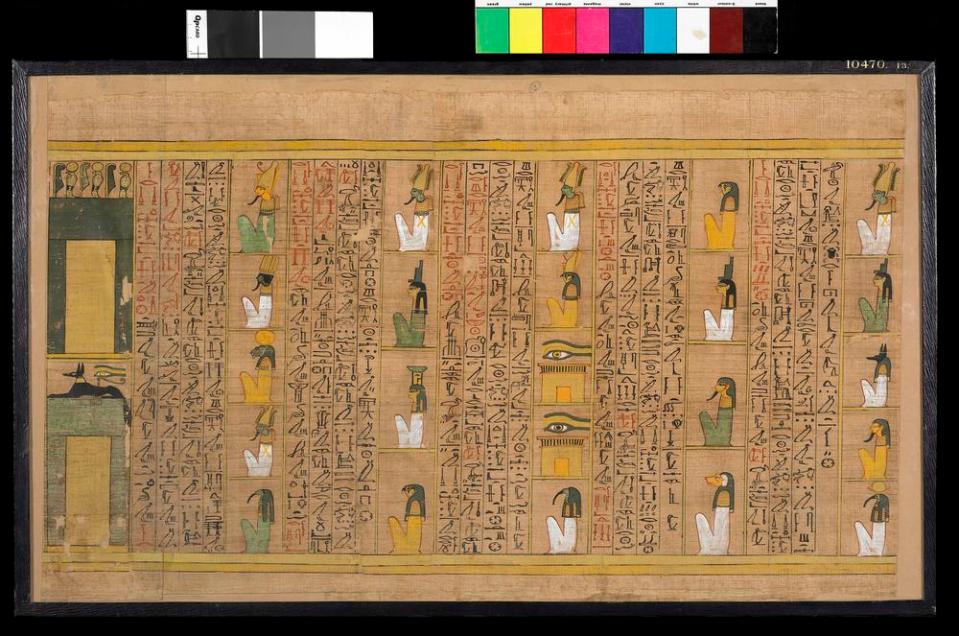
Once they’d reassembled *most* of his body, Isis used her magic to bring him back to life. Soon after, she got pregnant with a baby boy (more about him in another blog post!) and Osiris descended to the underworld, where he became the God of the Dead. Unsurprisingly, he pops up a lot in the Egyptian Book of the dead, which was basically a book of spells, allowing you to pass safely to the underworld.

Chapter 125 of the Book of the Dead at the British Museum—can you spot Osiris? It’s written on papyrus which is a reed that grows on the banks of the Nile river.
This gory myth features again and again in Egyptian art, and also in our treasure hunts! Keep an eye out for depictions of Seth, Isis, Osiris and Horus in many of our British Museum themes, such as Fun + Games, Love Hunt, and of course the chilling Skull Scouting. Keep an eye out the same cast of characters while scouting out the Zodiac of Dendera and the Sarcophagus of Ramesses III at the Louvre in our Skull Scouting and Beauty and the Bestiary hunts there. No doubt, when we expand to NYC’s Met, our fine friends here will reappear (Temple of Dendur, anyone? Which only costs 50K to rent out!).

By Halle Trang
It might come as no surprise to you that museums are very popular locations to film in. Some of the greatest museum halls in London and Paris act as great backdrops for action scenes, and the actual art pieces provide amazing visual appeal in music videos. We scoured the internet to find movie clips and music videos that were filmed in the very museums we host treasure hunts in. Keep reading below to find out which movies were filmed in the Louvre, Musee d’Orsay, British Museum, Natural History Museum, and the V&A!
JEAN-LUC GODARD’S BANDE A PART (1964)
Louvre, 40-second movie clip
This short clip comes from Jean-Luc Godard’s Bande á Part, which shows three naughty New Wave teens in the 60s, running through the venerable halls of the Louvre. How different the museum looked back then! Do you recognise the rooms they’re racing through or the Daru stairs they’re tumbling down? Can you imagine the stairs being as empty today?
THE CARTERS’S “APES**T” (2018)
Louvre, 6-minute music video
This is a 6-minute music video by Beyonce and Jay-Z in the Louvre taken place in the Denon & Sully wings at night. Please note there are many expletives in this song, so you may want to view before sharing it with your children. I show it to my kids every time we visit, quizzing them on naming the painters, dates, periods and titles of the works that appear (from Venus de Milo to Gericault’s Raft of Medusa and the Great Sphinx of Tanis), but completely understand if you want to edit this due to the swear words.
MARTIN SCORSESE’S HUGO (2011)
Musee d’Orsay, 1-minute movie clip of opening scene
Although it was once a train station, the Musee d’Orsay has now been transformed into the wonderful museum that it is. It is most commonly known for its clocks, which were repurposed and are now used as windows that overlook the beautiful city of Paris. This opening scene in Hugo shows the main character climbing to the top and looking out at the Parisian streets through the clock face.
ALFRED HITCHCOCK’S BLACKMAIL (1929)
British Museum, 3-minute movie clip
We can instantly recognise the tall columns of the British Museum’s main entrance in this movie clip, which shows a chase scene through the museum and what was once the British Library. This was one of Hitchcock’s first films to have a chase scene near a famous landmark, foreshadowing other greats like North by Northwest. Imagine if we had access to the domed roof like the actors did!
PAUL KING’S PADDINGTON (2014)
Natural History Museum, 4-minute behind-the-scenes video
Taxidermist and antagonist Millicent Clyde, played by Nicole Kidman, only has one goal in mind: capture Paddington the bear for his rare hide. This clip gives viewers a behind-the-scenes look into the making of the film. Many of the Kidman scenes take place in the museum’s animal exhibitions, but can you spot any other famous attractions? (Think dinosaurs!)
ALEX KURTZMAN’S THE MUMMY (2017)
Natural History Museum, 1-minute behind-the-scenes video
Once again, a movie is filmed displaying the grand staircase in the central hall of the Natural History Museum. In this short 1-minute clip, Tom Cruise’s character is seen running across this area as shards of glass and dust fly towards him. Do you think the museum looks exactly the same as in the 2014 film Paddington?
THE CHEMICAL BROTHERS’S “HEY BOY HEY GIRL” (2008)
Natural History Museum, 3-minute music video
Our third find in the Natural History Museum comes not from a film, but a music video! The Chemical Brothers, a British big beat duo, came out with this song in 1999, but it wasn’t until 2008 that the music video for it was published on Youtube. In this music video, a young schoolgirl roams around the museum on her own and stares in fascination at the various skeletons and fossils around her.
DAVID KOEPP’S MORTDECAI (2015)
Victoria and Albert Museum, 2-minute movie trailer
The National Art Library’s reading rooms found in the Victoria and Albert Museum (V&A) in London are popular filming areas due to their grandeur and great lighting. In this movie trailer, you can see Lord Charlie Mortdecai (Johnny Depp) and Inspector Alistair Martland (Ewan McGregor) discussing a missing painting in those exact reading rooms from 0:25-0:37.
Can you think of more films or music videos that take place in any other museums across London or Paris? Let us know in the comments below!

We get it.
Kids don’t always love museums. You’ve tried your best, we know. The day begins well, with the whole family excited for a trip to the museum. Maybe your kids last an hour. A little more, if you’re incredibly lucky. Or maybe just a few minutes. But somewhere along the lines, the meltdown begins. The fun-filled day out you envisioned starts to seem like a distant dream.
The kids are tired. They’re hungry. Museums are boring anyway. Who wants to traipse around looking at old stuff when you could be watching TV?
And the truth is, you’re tired too. A part of you wonders if the kids are right. Are museums just boring, dusty old places? Because no matter how genuinely fascinating the exhibits, “museum legs” are a thing.
Is it your fault your kids just aren’t into this museum thing? Have you doomed them to a colourless, cultureless life? Will these traumatic childhood experiences leave them refusing to visit museums at all as adults?
Well, no. The truth is, we all feel like this at one point or another. But, while it’s tempting to think that maybe museums and kids just don’t mix, this simply isn’t true.
At THATMuse, we’ve helped hundreds of people visit some of the biggest and best museums in Paris and London. Lots of those people are families with kids aged from 5-13. And guess what – most of them leave saying that the British Museum is one of the best things to do in London with kids. Or that their trip to Paris with kids wouldn’t have been complete without a visit to the Louvre.

How is this possible?
If even your local museum exhausts your kids (and you), how could you possibly fathom bringing them to some of the largest museums in the world? Because although the Louvre, the British Museum, the Musée d’Orsay & the V&A are among the most beautiful, impressive museums in the world, their sheer size mean that they are a challenge. For anyone. The Louvre alone contains eight miles of museum, for God’s sake.
The answer is pretty simple. And it’s something you can totally do on your own.
There’s one missing ingredient from your museum trips:
Competition.
That’s it.
After all, all parents have tried it:
“I bet you can’t tidy up your bedroom faster than your sister!”
“Let’s see who can be the first to finish their greens!”
“The first one ready at the door in their shoes and coat gets a treat!” (because after all, what is a competition without a prize?).
Museums are no different. By making them a game – one that can be won – you make museums… well, fun.

3 Ways to Inject Some Competition into Your Day at the Museum:
- The Miniature Museum Treasure Hunt:
This particularly simple game works best with art museums. Pick something – anything – and have your kids compete to see who can spot the most of them. It really could be almost anything. Dogs. Angels. Redheads. Paintings of people who look like Grandma. Or better yet – have the kids pick something themselves.
Hint: things tend to stick in kids minds more if they’re gory, weird, or gross. Ask your kids to choose what they want to be on the hunt for, and don’t stress if they choose “skulls” or “ugly guys” or “boobies”. It’s their game, and if it makes it more fun for them, why not (though maybe have a chat beforehand about which words its appropriate to shout to their siblings from across the gallery).
2. The Postcard Game:
All museums have a gift shop, and all museum gift shops have postcards. Visit the gift shop before entering the main museum, and have the kids pick 3-5 postcards of pieces they like the look of (they’re usually quite cheap). Then, have the kids hold the postcards and hunt out the pieces themselves. Want to add some extra incentive? While in the gift shop, have the kids pick out their “prize” (within whatever price limit you decide on), on the promise that you’ll return to buy it afterwards if they complete their treasure hunt.
Hint: this works best in smaller museums – hunting the entirety of the Louvre or British Museum for one piece (unless it’s the Mona Lisa or the Rosetta Stone), is probably a bit too challenging, and puts your kids at risk of getting bored before they find their treasure.

3. The Imitation Game:
Challenge your kids to recreate as many paintings, sculptures or artefacts as they can, using nothing but their own bodies. They’ll have fun picking pieces to imitate, contorting themselves and being silly, and if you photograph it all, you’ll end up with some great shots for the album. What’s not to love? You might have to get a bit creative as to how to turn it into a competition, but perhaps you could have another family member judge who “wins” for each piece the kids choose to imitate.
Hint: To make it even more fun, join in! As we said before, kids remember silly things, so seeing you – their all-knowing, sensible parents turn yourselves into Michelangelo sculptures and Egyptian mummies will most likely stick in their minds forever. Embarrassed? Good! That just makes it all the more memorable.
Need some extra help?
You can do all of this and more all by yourselves, in any museum. The kids will benefit from soaking up all that lovely museum-juice, and may even learn a thing or two.
If you’re visiting Paris or London with kids and would like a bit of extra help, THATMuse is ready to turn your miserable museum meltdown into a memorable day out.
Our hunts have been tried, tested and triumphed over by hundreds of kids. Some of those kids are now adults, and we’d be willing to bet they still remember their dads posing on all fours like a dog to win bonus points, or rushing against the clock with mom past magnificent Roman sculptures to try and rack up just a few more points.
The best part? It’s never been easier to book a Treasure Hunt with THATMuse! You can now book your Louvre Treasure Hunt with “friendly competition” directly online, by using our automated booking service. Ready to pit family against another like-minded group?
Click here to book your THATMuse Louvre treasure hunt today!


Dubbed the first national public museum in the world, the British Museum didn’t start off as a grand, Greek-style building full of Egyptian mummies, Roman statues and Aztec turquoise. The museum has changed quite a bit in its almost 300-year history, but began with the donation of Hans Sloane (above), a high-society Irish physician – who also invented hot chocolate. What claims to fame!
Upon his death in 1753, Sloane bequeathed his collection of fantastic antiquities, books, and natural specimens to the nation. King George II and Parliament wanted Sloane’s collection to be seen by the people, not sit in a basement somewhere collecting dust. So later that year, Parliament passed the The British Museum Act, which formally established the British Museum at Montagu House – which stood on the spot of the current British Museum. To add some variety to Sloane’s science-heavy collection, Parliament included the Cottonian Library and Harleian manuscripts in the new museum for a taste of literature and art.
FUN FACT: The board of trustees almost bought a place called Buckingham House, which some of you might know better as its current incarnation – Buckingham Palace.
As the collection grew, so did the museum. In the 1880s, the natural history collection had grown enough to become a museum in its own right. The collection moved to a building in South Kensington, in what we know now as the Natural History Museum.
FUN FACT: Entry to the Natural History Museum is free. It has a fantastic collection of dinosaur skeletons too, including a famous 26-meter-long diplodocus. Check it out – and when you’re done, maybe go on a THATMuse treasure hunt at the V&A next door!
One of the most prominent additions to the British Museum was the introduction of the Elgin Marbles of the Parthenon, brought to the museum in 1812 by Lord Elgin. In 1931 funds were given by the controversial Sir Joseph Duveen to construct a new gallery for the Elgin Marbles. However, WWII got in the way and the gallery wasn’t opened until 1962. It was American architect, John Russell Pope, who designed the new gallery that you can now see today. Pope also designed the National Gallery in DC!
On the note of design, Robert Smirke is the man responsible for most of the recognizable parts of the British Museum you see today. The Quadrangle, the main section of the British Museum, was completed in 1852. You can still see it in the basic structure of the museum today, with wings in the north, south, east, and west. The first room to be competed was the Kings Library, finished in 1827. The library was one of main reasons the new building was built in the first place. King George the IV donated books belonging to his father, King George III, and the British Museum just didn’t have room for all of them! You can still see the restored Kings Library, though it is now called “The Enlightenment Room.”
FUN FACT: The original design for the British Museum included dorms for museum staff, as the museum workers lived on site– which was common practice in those days!

While the majority of the current British Museum was designed by Robert Smirke, one of the British Museum’s most distinctive features, the central court and dramatic glass ceiling (above), was designed by Norman Foster’s company (who also designed the famous Millenium – AKA “Wobbly” – Bridge!) The Queen Elizabeth II Great Court transformed the museum’s inner courtyard into the largest covered public square in Europe. The Great Court was a massive undertaking and was completed in 2000 to celebrate the new millennium. This beautiful and impressive space greets visitors as they first enter the museum – and what a vast number of visitors that is! For the past eight years, the British Museum has remained the U. K’s no.1 visitor attraction. Last year over 6.6 million people visited the British Museum to see the amazing history that it contains.

THATKid Tuesday is a monthly dose of Art History for kids, which will usually be posted on the first Tuesday of the month. In this series we’ll be blogging about different terms from the THATKid glossary we’ve created to help kids understand some of the art history terms that pop up in our hunts.

Continuous Narrative is when one painting, or piece of art, tells different parts of a story all at once. This means that the same figures are often shown over and over again in the same piece. This Greek Gorgon Pot, part of the Beauty & the Bestiary hunt at the Louvre, is an example of Continuous Narrative. The Greek pot above shows Perseus killing the monstrous Gorgon named Medusa. After Perseus has killed Medusa the pot also shows him being chased by Medusa’s Gorgon sisters. Kind of like a pre-classical movie or Snapchat story!


If you go on our THATMuse hunt at the British Museum you’ll see yet another example of continuous narrative involving someone being chased, although this time it’s the people chasing the ‘beasts’ and not the other way around. The Assyrian Lion Hunt from Mesopotamia shows different stages of a lion hunt, including the fate of this unfortunate lion on the left! Although other parts of the story might make you feel a bit less sorry for the lions and a little more scared of them – look at the muscles in that lion’s arm, look at those claws!

Any questions about Continuous Narrative? Leave us a comment with any questions.
The idea for THATKid Tuesday stemmed from the Kid Pack’s glossary. The Kid Pack has supplemental exercises for after your Louvre hunt, from a Michelangelo Connect-the-Dots and a Mona Lisa sticker-puzzle to a Botticelli Spot-the-Difference. Good for train rides or long French dinners, kids can also pick up on some terms like composition, perspective and the lot. As THATMuse has grown to include the British Museum, the Victoria & Albert and Musée d’Orsay, THATKid Tuesday’s blog version has grown to include other examples.
Tune in the first Tuesday of the month if you’d like another art history dose of THATKid.
