

The Aztecs in the British Museum

The Aztecs had an extensive empire in Mexico, ruling from the Island metropolis of Tenochtitlan, in Lake Texcoco. They forged an imperial dynasty based on military prowess and a network of long-distance trade and tribute routes that stretched from the Caribbean to the Pacific. They treasured the precious stone, turquoise, which among other green stones symbolized life-giving water and the sources of fertility. The mineral was scarce, and reserved for ritual objects and ceremonial regalia worn by priests and rulers. Aztec trading emissaries went as far as the South-West of North America (think Texas, New Mexico and Arizona) where there were mines of turquoise. However, only about 55 turquoise mosaics are known to have survived. Taking the scenic route to the BM’s room 27, here there are 9 of their finest examples. The BM bought them in Continental Europe – it’s thought that they may have made their way to Europe via Spanish Conquistador Hernan Cortes, who the Aztecs would have presented with such treasures upon his arrival to the coast of Mexico in 1519 AD.

Examples range from one of the BM’s highlight, a double headed snake. To a frightening skull, who would have dangled around the waist of a priest while he was making sacrifices (think cutting the heart out of some poor schmoe!). Then there are turquoise mosaics, such as on the handle of the sacrificial knife, in case the skull didn’t drive home the gruesomenature of their sacrifices, this knife was actually used in obtaining the live, blood-pumping hearts from their sacrificial victims!
A high priest would have needed their hands free (to hold the knife, presumably!), so the priest would have worn the skull dangling around his waist while performing a human sacrifice which was made in the belief that blood offerings kept the sun on its course. Now how’s that for grisly & gross?
Remember, hunters, if a sentence is bold it’s likely to be helpful on bonus questions for while you’re hunting!

To close off our new Islamic wings visits, we’re hopping across the pond from London’s Victoria and Albert Islamic Wing to NY. In 2011 The Met opened 19,000 sq feet (1770 m) of space devoted to Islamic art (the formal name of which is so long I’m not going to bother with it here). They haven’t had a new wing devoted to Islamic art since 1975. Worse, still, that was closed in 2003 to make room for the expanded Greek and Roman wing (which is utterly divine, by the way). The irony being, of course that this decision was made 2 years after 9/11, the very same year Chirac was ordering the Louvre’s Islamic collection. At the time plenty of critics pointed out that the west was being given priority so literally over the middle east.

Met, stanboul2000.wordpress.com
Mistakes aside, the Met’s made right and after nearly a decade of debating has invested 50 million dollars to showcase their 12,000-piece strong Islamic collection. Construction started in 2009, in the midst of economic hardship, and this past November opened their 15 rooms. I would like to have a brief visit with the naturalist painter, Mansur, a fine Indian included in the permanent collection, but just a quick aside:
The Met made an interesting decision to include a 16th century illuminated manuscript folio of the Prophet Muhammad. Thomas Campbell, de Montebello’s replacement, said “we hope that does not become a lightening-rod issue.” I don’t much care for Campbell (basically because he’s not Philippe de Montebello. When I was at Vanity Fair and fearful of losing any cultural education, I volunteered at the Met often, which is when I fell in love with the cadence of de Montebello’s voice and fine lemon-lipped accent. He could be telling the room the sky was blue and I’d find it sublimely insightful), but I respect Campbell for saying that the reason Muhammad is included is because they didn’t want to be accused of ‘ducking’ the issue.

There are tons of pieces to choose from, among them the Damascus Room, an 18th C wood-paneled reception chamber entirely intact, but for now I’d like to have a small visit with this blue bull, Nilgai. It is a page or leaf from the Shah Jahan Album (aka the Emperor’s Album or the Kevorkian Album).

Ink, opaque water color and gold on paper, he’s painted by the “Wonder of his age”, Mansur. During Jahangir’s reign (1605-1627) in the Mughal Empire, the painter Mansur accompanied the Emperor everywhere in order to paint page after page of natural phenomena. I suppose one could argue that Jahangir would have surely been a blogger, because as a copious diary keeper, he also insisted on having drawings to enhance his stories. And nature was his muse. This finely framed, delicate-legged bull antelope is taxonomically correct apparently. I wouldn’t know I haven’t ever seen an antelope, let alone a blue-tinged bull antelope. But there’s something sweet about the fellow. Here’s a real one, though he doesn’t look so blue to me, nor so sweet with those sharp horns.

a real blue bull, aviandiversity.com
Perhaps I was struck by Mansur’s gentle soul because he reminded me of an old friend at the Louvre, Pieter Boel: Another 17th Century naturalist painter, who has made plenty of appearances in plenty of THATLous. Hmmmm. Thoughts for the next post are already bubbling!

Largest, Oldest, Most Famous. These adjectives catch my attention. Continuing on this thread of new Islamic art wings at major museums (the Louvre, The Met), we’ve crossed the channel to London’s Victoria and Albert. The centerpiece to the Jameel Gallery of Islamic art, which opened in July 2006, is just that: The largest, the oldest signed, and undoubtedly the most famous Persian carpet in the world. Behold the Ardabil Carpet.


When William Morris, an art referee for the museum at the time (and the grandfather of textile design), first saw the Ardabil carpet in 1893 he was smitten, describing it as “the most remarkable work of art … the design is of singular perfection …”, banging on in delirious delight. Morris didn’t know that it was one of a pair (the other of which is at LACMA in Los Angeles, and was at one point in JP Getty’s possession).
Measuring 10.51m x 5.34m (34.4 x 17.6 feet), it has over 26 million knots of silk and wool. The pair took more than 4 years to weave and were laid on the floor of the burial place of Shaikh Safi al-Din, the founder of the Safavid Dynasty. They were in the mosque of Arbadil (NW Persia) from 1539-40, when they were made on royal commission, till 1890 when they left Iran for England. The inscription of the weaver (who wasn’t really a slave, but probably using the word in humility)


The idea here is that the more you read of this THATMuse blog, the more likely you’ll be to find hints to existing THATMuse treasure… The more you read, the more you’ll win. This Ardabil carpet, however, is an exception. Not only would it be too easy to find in a THATVA, it is too fine to take photos of. Something sacred to even the THATMuse gods!


What more appropriate to the Beauty & Bestiary theme (or the Ladies au Louvre theme) than to linger on Three Graces (of which the Louvre has many – from Lucas Cranach’s to the Borghese 3 Graces) Bestiaries are fantastical animals, such as griffins, centaurs, unicorns, even gargoyles. They appear in all sorts of fun places, such as scrutinising Paris a-top the belfry of Notre Dame (Gargoyles), or overlooking Darius’s Palace at Susa (Griffins), as written about in the Benetton of Near Eastern Art.
So until I’ve reached a decision for the next THATLou, I’m going to linger on these two subjects, the Beauty and the Beast, and if you have a say on which subject would make the best THATLou theme, please feel free to either vote on the THATMuse facebook page or leave a comment here.

What personifies beauty or ladies in the arts for me are The Three Graces. The Encyclopedia Britannica (1974 edition) defines The Three Graces:
Greek = Charities, Latin = Gratiae. In Green religion = Goddess of Fertility. The name refers to the pleasing or charming appearance of a fertile field or garden. Their number varied in different legends, but usually there were three: Aglaia (Brightness also Elegance), Euphrosyne (Joyfulness also Mirth, Good Cheer) and Thalia (Bloom also, Youth and Beauty, Festivities).
Depending on the legend, they’re said to be the daughters of Zeus and Hera (or Eurynome is the daughter of Oceanus sometimes) or Helios and Aegle (a daughter of Zeus). Frequently the Graces were taken as goddesses of ‘charm’ or ‘beauty’ and hence were associated with Aphrodite (the Goddess of Love), Peitho (her attendant) and/or Hermes, a fertility and messenger god.
In early times they were often represented with drapery, but by the time the Romans got to them they were usually full-fledged flashing us: Unembarrassed of their beautiful form, and usually draped around one another opposed to in drapes. More to come on them this week.

An example of Bestiary, to wait their turn and be covered after lingering on some beauty with various Three Graces…

* The first image of the Three Graces is a sculpture by Antonio Canova (1814-1817), which is currently at the Victoria and Albert Museum in London, who launched a public campaign to purchase it, much the way the Louvre bought Lucas Cranach’s Three Graces with another museum grassroots campaign.

Here are a few Chelsea places we’ve done score tallying for both travelling families on Luxe Hunts as well as for group hen hunts and prize giving ceremonies for corporate clients like Random House and Superdrug. As the V&A and Natural History Museum are just across from each other, the directions remain the same:
Bunch of Grapes (Pub)

Bunch of Grapes is a lovely Victorian English pub, with original stensiled glass grand décor and dark woods throughout, with pleasant upstairs. We’ve conducted score tallying and prize-giving for up Random House here, a group of over 70 people. Bookings can be made online or by calling. Online booking for up to 8, requests can be submitted for large groups which are seated in the upstairs dining room. Service is always pleasant but it can be slow. This is a Greene King Pub.
Address: 207 Brompton Road, Knightsbridge, London SW3 1LA
Phone: 0207 589 4944
Hours: 11:00- 23:30
Prices: circa £10 – 16
Web:https://www.greeneking-pubs.co.uk/pubs/greater-london/bunch-of-grapes/menu/main-menu
Directions:
- Exit the V&A or Natural History Museum via the Exhibition Road Entrance/ Exit, turning right
- Turn left onto Cromwell Gardens
- Turn right at Brompton Square Turn Right on Brompton Square and you will have arrived at your destination!

Hoop and Toy (Pub)

Hoop and Toy is a cute, traditional English pub, with unique whisky and brandy bottle décor. It’s a cozy, welcoming environment, great for families and groups of friends and colleagues. Bookings can be made online or by calling. Online booking for up to 8, requests can be submitted for large groups. This is a Greene King Pub.
Address: 34 Thurloe Place, Kensington SW7 2HQ
Phone: 02075 898360
Hours: 11:00- 00:00
Prices: circa £10 – 16
Web:https://www.greeneking-pubs.co.uk/pubs/greater-london/hoop-toy/menu/main-menu
Directions:
- Exit the V&A or Natural History Museum via the Exhibition Road Entrance/ Exit
- Turn right and continue straight, eventually crossing Cromwell Road
- Turn Right on Thurloe Street- Hoop and Toy will be on your right, on the bend in the road

Honest Burgers

Honest Burgers is popular with kids and is just a short walk from either the NHM or the V&A. It has a cute, urban feel, and is better for small groups since the space isn’t that large. If you’re coming with a larger group, they would prefer that you call ahead two weeks in advance. Best availability is 3-6 on weekends. Honest Burgers offers mostly indoor seating but does have a few outdoor tables. Extremely friendly staff, eager to help and very attentive. Honest has both beef and chicken burgers, rosemary fries and delicious cocktails (preferred that drinks are ordered with food as the space is so small). Not extremely kid-friendly.
Address: 24 Thurloe Street, London SW7 2LT
Phone: +44 (0)20 3019 6440
Hours: Mon – Sun 09:30 – 13:00
Prices: circa £7 – 13 (menu here)
Web: https://www.honestburgers.co.uk/
Directions:
- Exit the V&A or Natural History Museum via the Exhibition Road Entrance/ Exit
- Turn right and continue straight, eventually crossing Cromwell Road Turn Right on Thurloe Street
- Honest Burgers is almost directly in front of you

The Kensington Creperie

The Kensington Creperie offers traditional French crepes just a short walk from the Natural History and V&A Museums. Crepes are offered as both savory and sweet and the café also serves waffles and a variety of smoothies, juices, milkshakes and hot drinks. Typically, reservations aren’t necessary, but you can always call ahead to check availability. This option is better for small groups and families.
Address: 2-6 Exhibition Road, South Kensington, London SW7 2HF
Phone: 020 7589 8947
Hours: Sun to Thurs: 9:00 am – 11:00 pm Fri to Sat: 9:00 am – 11:30 pm
Prices: circa £5 – 15
Web: http://kensingtoncreperie.com/wp-content/uploads/2018/02/KC-Menu-1.pdf
Directions:
- Exit the V&A or Natural History Museum via the Exhibition Road Entrance/ Exit
- Turn right and continue straight, eventually crossing Cromwell Road
- The destination will be on your left (it has Green Awnings)


The Percy Jackson series tells the stories of the half-mortal / half-god children (called demigods) of the ancient Greek Mythology. The story follows Percy, son of Poseidon, and his friends at Camp Half Blood, which is the only place where young heroes are really safe from the monsters that constantly hunt them.

As important as Camp Half Blood is, the Parthenon (the 5th Century temple in Athens), is at least ten times more important. The Parthenon is easily the single most important building to the Western Cannon of architecture. It was built as an offering to the goddess Athena, the Greek goddess of wisdom, and mother to Annabeth Chase of Rick Riordan’s Percy Jackson series. On our Fun & Games treasure hunt, we ask you to count how many Chariots are on the Parthenon’s frieze, which runs the length of the British Museum’s most famous treasure. These treasured stones, which the English call the ‘Elgin Marbles’, were stolen from Greece by Lord Elgin in 1805-1807. Elgin’s day job was ambassador to the Ottoman Empire (Constantinople, the capital, is the old name for Istanbul), but he was really interested in archaeology.
True to his role as an Imperialist Ambassador, Elgin was also a stone robber; so when he stopped off in Athens he stole the freestanding statues of the Pediment (showing the Gods and Goddesses), the reliefs of the Frieze (mere mortals or humans in a procession giving donation to Athena) and the square reliefs of the Metopes (telling the story of Centaurs fighting Lapiths – more on those Centaurs, half man, half horse, in a moment!).
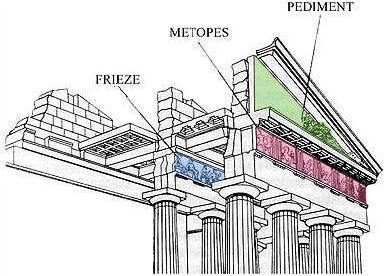
Can you think of a building in your home town that is loosely based on the Parthenon, with pediment, frieze and a forest of columns (known as a portico, it protects visitors from the rain)? When you visit the British Museum, whose façade is a copy, you’ll see this.
In the books by Riordan, Annabeth spends a lot of time mastering both flying chariots and chariot races. Much like the charioteers depicted racing in the Olympic games on this ancient temple to Athena, trying to establish athletic superiority and gain honors, Annabeth and her fellow campers raced to determine honors as well. The campers of Camp Half Blood however, compete for positions far much more coveted than Gold, Silver and Bronze, they compete for the best chore slots in the camp.

In The Sea of Monsters, Percy and Annabeth compete together against the other cabins, alternating between who was the driver and who fended off the magical attacks of the other campers as they raced. Chiron, the camp leader (and a centaur) had previously banned chariot races because they were so dangerous, but with his absence in this book, they were re-instated. They might not have had magic in the chariot races in Ancient Greece, but chariots were decked out with all sorts of weapons used to secure victory. Look closely and you might even find some!

When you look at the metopes you’ll notice that they tell the story of some rowdy centaurs (most likely the Party Ponies) crashing a Lapith wedding. The Centaurs planned on stealing Lapith wives (they failed, the Lapiths won!).
If you’ve read Percy Jackson you’ll know that Chiron doesn’t act like a Party Pony any more, but back in his youth he certainly did. Who knows, Chiron could very well be one of the centaurs (half man, half horse) that are forever immortalized on the Parthenon!
Any comments, or queries about the Elgin Marbles? Just post below!
As for reading this blog post, you’ll be well rewarded with having learned the answers to some potential bonus questions – such as how many chariots are on the frieze (we count 8), what parts of architecture the Pediment, Frieze and Metope are as well as thinking about just HOW you can get your team to pose as one of the fighting centaur and lapiths… not so hard if you’re willing to sell your price, except your THATMuse challenge is to do so without heads, true to these Parthenon metopes!

MEETING POINT

Your first task will be to find our meeting point on Great Russell Street, just outside the BM’s main gate. If facing the museum your greeter, will be just to the left of the entrance (photo above), across the road from a Starbucks, near a red London phone booth (photo below) with a signature white canvas THATMuse tote. Together you’ll navigate security & coat checks before a brief history of the museum & we set you up on your treasure hunt within the museum’s famous Great Court!

Your THATMuse Mission
Photo your team in front of as many pieces of THATBrit Treasures as possible within the given amount of time (90 mins to 2 hrs) With each photo you’ll earn 20 game points (about 500 game points), however, with careful reading you could pick more than 1000 bonus THATMuse points & Letter Scramble spelling out your prize treasure with THATMuse Letters embedded in the text! We’ve intentionally provided more treasure text & fun than you could read about within the given time in the hope that you’ll want to return or extend your visit (& to ensure strategy!)
TOOLS
Please be sure to have freshly-charged batteries in your phone or camera, as it’s a photo-based game!
RULES
(in addition to photographing your team in front of as many pieces of treasure as possible)
- Teams must stay together at all times, must not run, jump or shout
- No external help… If seen speaking to a tourist-in-the-know or BM staff you’re automatically eliminated; Likewise, no googling the Mesopotamians, no GPS-ing where the Greeks are, or anything other than your hunt & map… No phoning your Egyptologist Aunt for help, either!
- Please be sure you have one (1) Master Copy with all the answers and only use one (1) camera/phone (to facilitate score tallying). In respect to Museum policy please mute your phones & no flash photography
- Must meet back at starting point (X on your map) at the precise time agreed. Each minute late merits 5 negative points, per minute (!!) There are sometimes strategical reasons to be late, but attention (!!): if you’re more than 10 mins late you’re ousted!
For small doses of Museum/Art Trivia, tune in (share or contribute your own!) to our daily Twitter (@THAT_Muse_) page for #THATMuseFacts! Or just #THATMuse for your hunting snaps!
MEETING POINT
Your first task will be to find our meeting point within the British Museum’s Great Court lobby. If entering the museum from the main entrance on Great Russell St, the circular Information Desk is to the right (within the Great Court); we’ll meet behind the Info Desk, at the Roman equestrian prince statue (photo herewith). Your THATBrit Rep will have a white canvas THATMuse tote.

TOOLS
Please be sure to have freshly charged batteries in your phone or camera. Please visit the cloak room &/or toilet before our meeting time.
ROLES
- Navigator (good with a map)
- Scribe (who’s got the best penmanship?)
- Reader (the lawyerly type who’ll catch bonus questions embedded in the treasure text)
- Organiser (who’ll keep an eye on the clock and make sure you’re in order) and of course the photographer. Some of these roles can overlap, of course.
Your THATMuse Mission
Photo your team in front of as many pieces of THATBrit Treasures as possible within the given amount of time (90 mins to 2 hrs.)
With each treasure photo you’ll earn 20 game points (about 500 game points), however, with careful reading you could pick more than 1000 bonus THATMuse points. There are several ways to do this. Our bonus questions fall into three key categories:
– Scrutiny (looking more carefully at the piece or surrounding rooms)
– Silliness (willing to trot like a Tang horse for bonus points?)
– Knowledge (All of these questions can be answered within another piece of treasure text, within the hunt)
There is also an artistic challenge & Letter Scramble spelling out your prize treasure with THATMuse Letters embedded in the text, both worth 100 bonus THATMuse points! We’ve intentionally provided more treasure text & fun than you could read about within the given time in the hope that you’ll want to return or extend your visit (& to ensure strategy!)
THATMuse is entirely independent of the British Museum as such, we unfortunately have no control of rooms they close off (which changes within the day)
RULES
(in addition to photographing your team in front of as many pieces of treasure as possible)
- Teams must stay together at all times, must not run, jump or shout
- No external help… If seen speaking to a tourist-in-the-know or BM staff you’re automatically eliminated; Likewise, no googling the Mesopotamians, no GPS-ing where the Greeks are, or anything other than your hunt & map… No phoning your Egyptologist Aunt for help, either!
- Please be sure you have one (1) Master Copy with all the answers and only use one (1) camera/phone (to facilitate score tallying). In respect to Museum policy please mute your phones & no flash photography
- Must meet back at starting point (X on your map) at the precise time agreed. Each minute late merits 5 negative points, per minute (!!) There are sometimes strategical reasons to be late, but attention (!!): if you’re more than 10 mins late you’re ousted!
For small doses of Museum/Art Trivia, tune in (share or contribute your own!) to Twitter (@THAT_Muse_) and FB page for daily posted #THATMuseFacts! Or just follow us to see fun #THATMuse hunting snaps!

MEETING POINT
Your first task will be to find our meeting point on Great Russell Street, just outside the BM’s main gate. If facing the museum your greeter, Daisy, will be just to the left of the entrance (photo above), across the road from a Starbucks, near a red London phone booth (photo below). Daisy has brown hair & will have her signature white canvas THATMuse tote. Her mobile is +44 (0)7921 589912 (on WhatsApp, too). Together you’ll navigate security & coat checks before she gives you a brief history of the museum & sets you up on your treasure hunt within the museum’s famous Great Court!

Your THATMuse Mission: Photo your team in front of as many pieces of THATBrit Treasures as possible within the given amount of time (90 mins to 2 hrs) With each photo you’ll earn 20 game points (about 500 game points), however, with careful reading you could pick more than 1000 bonus THATMuse points & Letter Scramble spelling out your prize treasure with THATMuse Letters embedded in the text! We’ve intentionally provided more treasure text & fun than you could read about within the given time in the hope that you’ll want to return or extend your visit (& to ensure strategy!)
TOOLS
Please be sure to have freshly-charged batteries in your phone or camera (it’s a photo based game)
RULES
(in addition to photographing your team in front of as many pieces of treasure as possible)
- Teams must stay together at all times, must not run, jump or shout
- No external help… If seen speaking to a tourist-in-the-know or BM staff you’re automatically eliminated; Likewise, no googling the Mesopotamians, no GPS-ing where the Greeks are, or anything other than your hunt & map… No phoning your Egyptologist Aunt for help, either!
- Please be sure you have one (1) Master Copy with all the answers and only use one (1) camera/phone (to facilitate score tallying). In respect to Museum policy please mute your phones & no flash photography
- Must meet back at starting point (X on your map) at the precise time agreed. Each minute late merits 5 negative points, per minute (!!) There are sometimes strategical reasons to be late, but attention (!!): if you’re more than 10 mins late you’re ousted!
For small doses of Museum/Art Trivia, tune in (share or contribute your own!) to our daily Twitter (@THAT_Muse_) page for #THATMuseFacts! Or just #THATMuse for your hunting snaps!

MEETING POINT
Appropriate to our company name, your THATMuse Rep will be standing at a bust of a ‘Muse’. Upon entering from the main Cromwell Road entrance, we’ll be directly to the left of the revolving doors (marked as Stairwell A on V&A maps of the ‘Grand Entrance’). Your THATMuse Rep will have a white canvas THATMuse tote.
TOOLS
Freshly charged batteries in your phones/cameras (per team) & comfy shoes.
Your THATMuse Mission
Photo your team in front of as many pieces of Treasure as possible within the given amount of time (90 mins to 2 hrs.)
With each treasure photo you’ll earn 20 game points (about 500 game points), however, with careful reading you could pick more than 1000 bonus THATMuse points. There are several ways to do this. Our bonus questions fall into three key categories:
– Scrutiny (looking more carefully at the piece or surrounding rooms)
– Silliness (willing to trot like a Tang horse for bonus points?)
– Knowledge (All of these questions can be answered within another piece of treasure text, within the hunt)
There are also a variety of more artistic challenges & Letter Scrambles spelling out your prize treasure with THATMuse Letters embedded in the text, worth 100 bonus THATMuse points! We’ve intentionally provided more treasure text & fun than you could read about within the given time in the hope that you’ll want to return or extend your visit (& to ensure strategy!)
RULES
- Teams must stay together, must not run, jump, shout & no no NO touching anything
- No external help… If seen speaking to a tourist-in-the-know or V&A staff you’re automatically eliminated; Likewise, no googling the Japanese, no GPS-ing the Fashion Dept, or using anything other than your hunt & map… No phoning your Sinologist Aunt for help, either!
- Please be sure you have one (1) Master Copy with all the answers and only use one (1) camera/phone (to facilitate score tallying). In respect to Museum policy please mute your phones & no flash photography.
- Must meet back at starting point at the agreed time. Each minute late merits 5 negative points, per minute (!!) There are sometimes strategical reasons to be late, but attention: if you’re more than 10 mins late, you’re ousted!

Quite a bit has happened to the Victoria & Albert Museum in its 165 year history – heists, bombings, construction and moments of brilliance. These posts are based off our #THATMuseFacts on Twitter – because a tweet sometimes isn’t enough! If you like learning about funny, interesting or just plain bizarre facts about some of Europe’s coolest museums, follow @THAT_Muse_ on Twitter and look for our quarterly “Top 10” posts like this one about the British Museum, Louvre and Musée d’Orsay!

1) In 1913, the V&A considered banning women because it feared militant suffragettes would vandalize the museum. After Mary Richardson took an axe to Velazquez’s The Toilet of Venus in the National Gallery, alarm spread through London’s museums and galleries. The suffragettes’ actions actually contributed to the V&A’s decision to do away with admission fees in 1914, reasoning that an increase in the number of visitors would act as extra security against possible attacks.
2) A V&A custodian named John Andrew Nevin was arrested and found guilty of stealing thousands of objects from the V&A in the 1950s.
Some of his loot included diamonds belonging to Catherine the Great, swords and Chinese jade, which he smuggled out by stuffing them down his trouser legs. When asked for an explanation, Nevin said, “I couldn’t help myself. I was attracted by the beauty.” In total, Nevin stole 2,068 items from the museum – the largest ever theft in terms of quantity from a British museum (not the BM!). (Read more here!)
3) The oldest photograph of London, probably taken in 1839, is housed in the V&A.

A man named Monsieur de St Croix took the photo from Trafalgar Square, looking down Parliament Street. It is actually a daguerreotype, so the picture is on a silvered copper plate. It is very detailed; if you look closely, you can see a statue of King Charles I and people who stayed still long enough to be in the photograph. The process of daguerreotypy was invented in Paris but quickly brought to London.
4) Two dogs—Tycho and Jim – are buried in the V&A’s John Madejski garden.

Jim, a Yorkshire terrier, belonged to Sir Henry Cole, the V&A’s first director. Cole would often take Jim to work at the museum with him and loved him dearly enough to have an enamel model made of the scruffy little dog. Tycho belonged to Cole’s son, Alan. And yes, this is a bonus question for some of our THATMuse V&A hunts, sending teams to find the plaques directly to the right, if entering the beloved garden courtyard from the V&A’s cafe entrance.
5) Aside from being the V&A’s first director and an exuberant dog lover, Henry Cole is also credited with inventing the Christmas card in 1843 (see below).

He commissioned a designer and a printer to create over a thousand cards that could then be personalized and sent to friends. Cole also made enough to sell, but they were expensive and deemed a commercial flop. But when Dicken’s novel “A Christmas Carol” was published, Christmas cards caught on. Yes, this trivia is in our Festivities hunt at the V&A — glad you read this post? (Read more here!)
6) The V&A was the first museum to create a public restaurant, which was originally called the “Refreshment Rooms.”
Henry Cole (he sure pops up a lot, doesn’t he?) managed the Great Exhibition in 1851 and saw that many visitors there enjoyed having a hot meal or tea while going about the exhibits. He brought the idea back when the V&A was opened so that guests could have a similar experience. However, the restaurant was described as “hideously ugly” and the original structure – which clashed horribly with the museum itself – was demolished 11 years after it was built.
7) The tallest object in the V&A is a plaster cast of Trajan’s Column, which stands 35.6 meters high!

In fact, it is displayed as two separate towers because it is too tall to fit inside the gallery. The Cast Court (including Trajan’s Column,) was installed in the V&A to allow people too poor to travel see culturally important works of art.
8) The Great Bed of Ware (which comes up in our “Festive Feasting” treasure hunt!) is, arguably, Britain’s most famous bed.

It is over three metres wide and, according tolegend, can hold at least four couples. The bed was famous enough in its day that Shakespeare referenced it in his play Twelfth Night, and 14th century tourists came from all over to lay eyes on it. Evidence of their visits can be seen via the carved initials and wax seals on the bedposts and headboard.
9) Horses and carts take up a lot of space – which the V&A learned when packages and post were delivered to the V&A and the horse did not have enough room to maneuver and get back to the street.
To deal with this issue, the V&A built a large turn-table – the horse just had to stand there and the floor beneath it would just rotate! Talk about inventive.
10) If you’re standing in front of the V&A, look up – you’ll see a large, imposing statue standing atop the building’s central tower.

This figure is Fame – and she’s not as scary as she looks, especially since she’s missing her nose!

GIRAFFE START & FINISH POINT
You’ll meet your THATMuse Rep at the Giraffes in the main Hintze Hall. They will have a white canvas THATMuse tote and prior to your hunt their name and contact details will be emailed to you.TOOLS
Freshly charged batteries in your phones/cameras (per team) & comfy shoes.Your THATMuse Mission
Photo your team in front of as many pieces of Treasure as possible within the given amount of time (90 mins to 2 hrs.) With each treasure photo you’ll earn 20 game points (about 500 game points), however, with careful reading you could pick more than 1000 bonus THATMuse points. There are several ways to do this. Our bonus questions fall into three key categories: – Scrutiny (looking more carefully at the piece or surrounding rooms) – Silliness (willing to trot like a Tang horse for bonus points?) – Knowledge (All of these questions can be answered within another piece of treasure text, within the hunt) There are also a variety of more artistic challenges & Letter Scrambles spelling out your prize treasure with THATMuse Letters embedded in the text, worth 100 bonus THATMuse points! We’ve intentionally provided more treasure text & fun than you could read about within the given time in the hope that you’ll want to return or extend your visit (& to ensure strategy!)RULES
- Teams must stay together, must not run, jump or shout & of course NO NO NO TOUCHING anything…
- No external help… If seen speaking to a tourist-in-the-know or staffer you’re automatically eliminated; Likewise, no googling Marsupials, no GPS-ing where fossilized skin is, no phoning your geologist Aunt for help!
- Please be sure you have one (1) Master Copy with all the answers and only use one (1) camera/phone (to facilitate score tallying). In respect to Museum policy please mute your phones & no flash photography
- Must meet back at end point (Queen’s Gate, near Darwin Centre) at the precise time agreed. Each minute late merits 5 negative points — that’s 5 pts debited! — per minute (!!) Sometimes there are strategical reasons to be late, but attention: if you’re more than 10 mins late you’re ousted, eliminated, no point in coming back… Ouch!
